
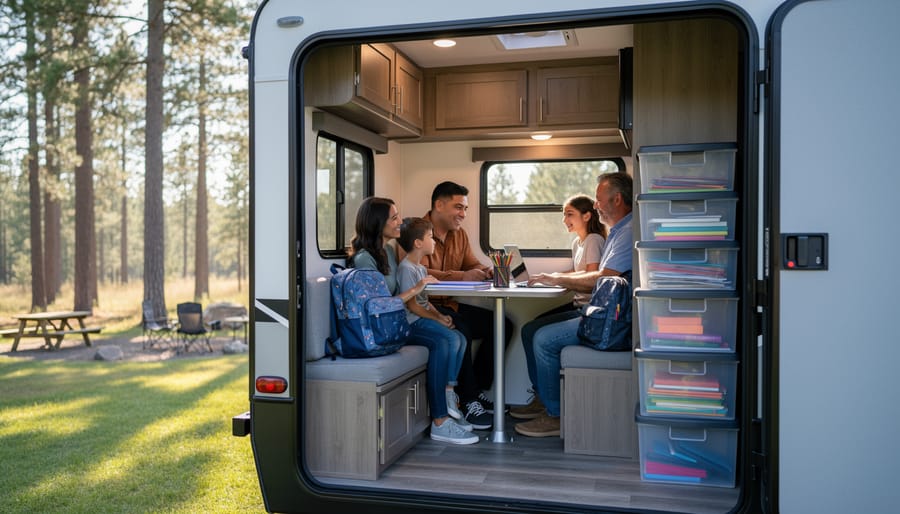
Living full time in a travel trailer is absolutely doable for individuals, couples, and families who want to embrace a mobile lifestyle while maintaining a smaller footprint and lower costs than larger RVs. Travel trailers offer the perfect blend of affordability, flexibility, and adventure, though they do require intentional downsizing, smart space management, and realistic expectations about what 200-400 square feet can comfortably provide.
We made the switch to full-time travel trailer life three years ago with our two kids, and I won’t sugarcoat it: the first month was rough. Our 28-foot trailer felt impossibly small after leaving a 1,800-square-foot house. But here’s what surprised us most: within six weeks, we stopped noticing the compact living space and started noticing everything we’d gained. We traded mortgage stress for campsite sunrises, homework battles for educational road trips, and weekend routines for genuine exploration.
The reality is that travel trailers present specific challenges that differ from fifth wheels or motorhomes. You’re working with less storage, tighter living quarters, and the need to tow your home behind a capable vehicle. But you’re also spending a fraction of the cost, maintaining easier maneuverability, and keeping the freedom to unhitch and explore without breaking camp.
This lifestyle isn’t about perfection or Instagram-worthy minimalism. It’s about families who choose experiences over square footage, who problem-solve creatively when three people need the bathroom simultaneously, and who discover that “home” has less to do with space and everything to do with the people inside it.
Why We Chose a Travel Trailer Over Other RV Types
When we first decided to go full-time, everyone had an opinion about what RV we should buy. Class A motorhomes, fifth wheels, toy haulers, friends and family threw out suggestions like confetti. But we kept coming back to travel trailers, and after three years on the road, I can tell you it was the right choice for our family.
The affordability factor sealed the deal initially. Travel trailers typically cost 30-50% less than comparable motorhomes or fifth wheels. That price difference meant we could buy a quality trailer without draining our emergency fund or starting this adventure in debt. We also avoided the massive depreciation hit that motorhomes take the moment you drive them off the lot.
But the real game-changer? Flexibility. With a travel trailer, our truck remains our truck. When we’re settled at a campground, we unhitch and suddenly have a vehicle for grocery runs, hiking trail access, and exploring back roads that no 35-foot rig could navigate. We’ve driven up mountain passes, through narrow historic downtown streets, and into remote trailheads, adventures that would’ve been impossible if our home and transportation were one unit.
The maneuverability surprised us too. Yes, backing up takes practice, but parking in campsites and navigating tight campground roads is easier with a 25-foot travel trailer than with a massive fifth wheel or motorhome. We’ve snagged beautiful spots that bigger rigs had to pass by.
For families specifically, this setup means flexibility when kids get restless. Someone can nap in the trailer while others explore. You’re not choosing between everyone staying home or everyone leaving. That independence has saved our sanity more times than I can count, especially during those growing-pain phases when our daughter needed alone time and our son needed adventure.
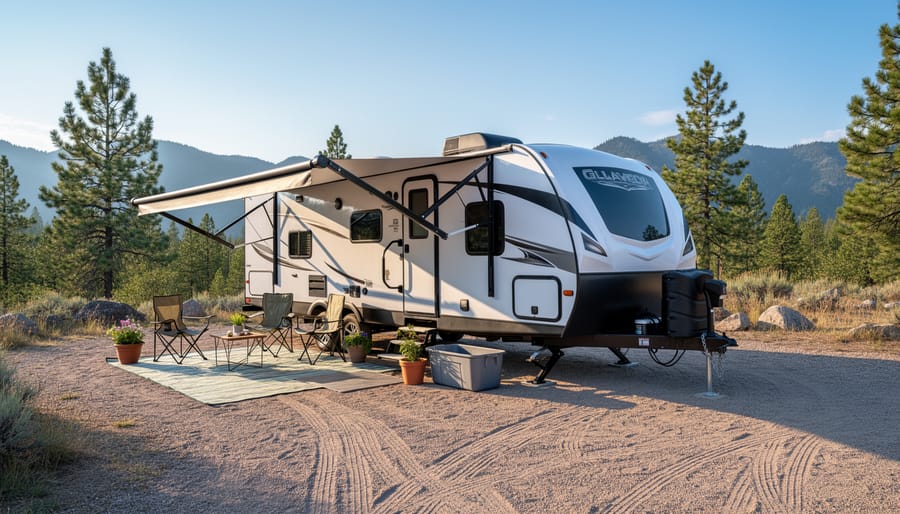
Finding the Right Size Travel Trailer for Full-Time Living
Space Planning for Your Family’s Needs
When we started mapping out our space needs, I discovered that square footage matters less than how intentionally you use every inch. Our 28-foot trailer has roughly 250 square feet of living space, which sounds impossibly small for four people until you realize that three-quarters of traditional homes sit empty most of the time.
Start by listing your family’s non-negotiables. For us, that meant separate sleeping areas for the kids, a functional workspace for remote work, and enough table space for homeschool projects. A couple traveling full-time might prioritize a comfortable desk setup and storage for hobbies over bunk beds.
Sleeping arrangements drive most decisions. Families with young kids often do well with bunkhouse models featuring rear bunks and a separate master bedroom up front. Teens need more privacy, making slide-out dinettes that convert to beds or Murphy bed setups valuable. Count actual sleeping spots, not marketing claims. That “sleeps 8” tag usually includes dining benches nobody wants to sleep on long-term.
Work and school spaces require dedicated surfaces and decent lighting. We claimed the dinette for schoolwork during mornings, then cleared it for meals. One parent uses a fold-down desk in the bedroom for video calls. Vertical space becomes crucial when floor space vanishes. Think walls, not just cabinets. Every family member gets one designated storage bin for personal items. That’s it. This forces periodic purges and teaches kids that experiences matter more than stuff.
Understanding Weight Ratings and Towing Capacity
When we started researching travel trailers, the weight ratings felt like alphabet soup. Here’s what actually matters: GVWR (Gross Vehicle Weight Rating) is the maximum your loaded trailer can safely weigh, including everything you pack inside. Your truck’s towing capacity, now standardized under SAE J2807 towing capacity ratings, must exceed this number, but there’s a catch most families miss.
Payload is the weight of everything you add after purchase: clothes, food, bikes, water in the tanks, that collection of stuffed animals your kids refuse to leave behind. We learned this the hard way when our “lightweight” trailer gained 1,200 pounds once we actually moved in. Dry weight specifications mean nothing for full-timers.
Calculate your real math this way: weigh your packed truck at a truck stop scale, then add your trailer’s GVWR (not dry weight). That combined number needs to stay well below your truck’s ratings with a safety margin. We aim for 80% of maximum capacity, which gives us breathing room for that unexpected antique dresser we find at a flea market or the firewood we stock up on out west.
Making a Travel Trailer Feel Like Home
Storage Solutions That Actually Work
Living in a travel trailer full-time taught us quickly that vertical space is your best friend. We installed tension rods under our dinette seats to hang spray bottles and small cleaning supplies, freeing up precious cabinet real estate. Those same under-seat storage areas became our bulk pantry once we added stackable plastic bins with labels, the clear ones let you see what’s running low without digging.
The kids’ stuff was our biggest challenge until we discovered over-the-door shoe organizers. We mounted them inside closet doors for toys, art supplies, and small clothing items. Each pocket holds exactly one activity or outfit, making it easy for even young kids to grab what they need and put it back.
Our game-changer was magnetic containers stuck to the range hood and any metal surface we could find. Spices, bobby pins, small tools, they all found a home on previously wasted wall space. We also swapped our bulky dish rack for a collapsible silicone one that slides into a drawer slot.
Under the bed, we ditched the random storage tubs for uniform-sized containers on wheels. Rolling them in and out beats crawling around on hands and knees. Each container serves one category: winter clothes, camping gear, or homeschool supplies.
The bathroom got slim rolling carts that fit beside the toilet, holding toiletries we used to pile on the tiny counter. Everything has a designated spot now, which sounds rigid but actually makes life smoother when four people share 200 square feet.
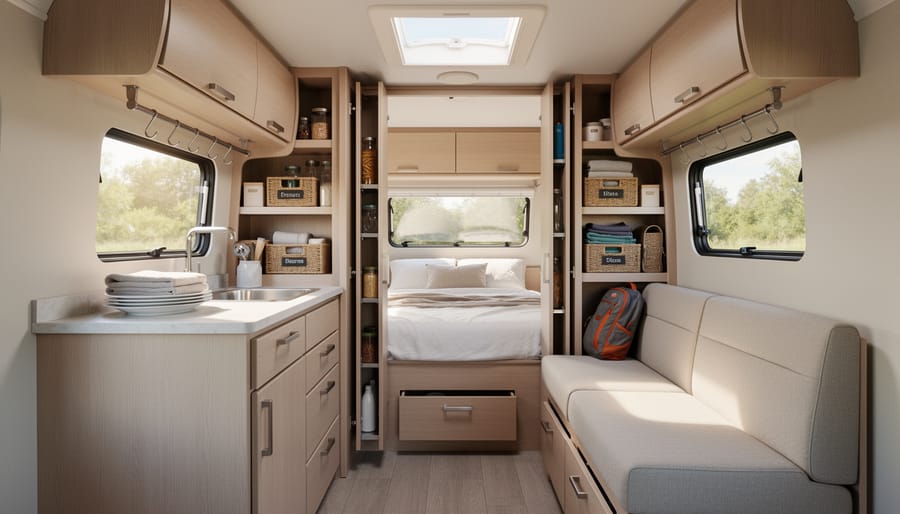
Creating Separate Zones in a Small Space
Living in 280 square feet with three kids taught us that zones aren’t about walls, they’re about intention and routine. The key is training everyone to associate specific areas with specific activities, even when those areas overlap throughout the day.
We turned our dinette into our work-and-school headquarters during morning hours. Charging stations live there permanently, along with a small basket of school supplies that slides under the bench when we’re done. After lunch, the same table transforms into craft central or game space. This mental shift works because we physically reset the space each time, clearing the table, wiping it down, and swapping out what’s on it.
The most valuable lesson? Your cooking zone needs the tightest boundaries because it’s the most dangerous. We established a strict “no kids in the kitchen during meal prep” rule from day one, which also forced us to master easy camping meals that don’t require constant supervision. A small rug marks where the kitchen ends and the living space begins, surprisingly effective with younger kids.
For sleep zones, we use blackout curtains that section off the bunkhouse and master bedroom, but the real game-changer was assigning everyone their own “personal bin” that stays in their sleeping area. Kids keep books, stuffed animals, and whatever else brings comfort in their space, giving them ownership and reducing the “where’s my stuff?” chaos.
Headphones became mandatory for anyone watching screens or listening to music. This single rule preserved our collective sanity more than any physical barrier ever could.
The Daily Realities of Travel Trailer Life
Our first morning in the travel trailer as full-timers started with a comedy of errors. I opened the bathroom door and nearly knocked my husband’s coffee off the dinette table. He stood up to help and blocked the hallway while our daughter tried to get her breakfast from the fridge. We learned fast that timing and choreography matter more in 280 square feet than they ever did in our house.
The morning routine now runs smoothly because we’ve established a rhythm. One person showers while another makes coffee and starts breakfast prep. We take turns getting dressed in the bedroom, and nobody opens the bathroom door without announcing it first. These small adjustments became second nature within a few weeks, but initially, it felt like learning a complicated dance.
Meal preparation requires more planning than it did in a full kitchen. Our three-burner stove and limited counter space mean I prep ingredients strategically, using cutting boards that fit over the sink for extra workspace. I’ve shifted to one-pot meals and sheet pan dinners that minimize dishes and maximize flavor. Checking out camping meal ideas helped us discover recipes perfectly suited to our smaller kitchen setup.
Laundry happens at campground facilities or laundromats, typically once a week. We keep a collapsible hamper under the bed and pack laundry supplies in a dedicated bag. Some full-timers install compact washers, but we’ve found the weekly laundromat trip gives us a reason to explore the local area while clothes spin.
Managing utilities becomes routine once you understand your trailer’s capacities. We check the freshwater tank every other day and monitor the gray and black tank levels through our control panel. Dumping tanks felt intimidating at first, but after a dozen times it’s just another chore, like taking out the trash used to be.
The reality is that full-time travel trailer living requires intentionality in everything you do. You can’t mindlessly leave lights on or run water while brushing your teeth. But this mindfulness has become one of the unexpected benefits, teaching our whole family to be more aware and resourceful.
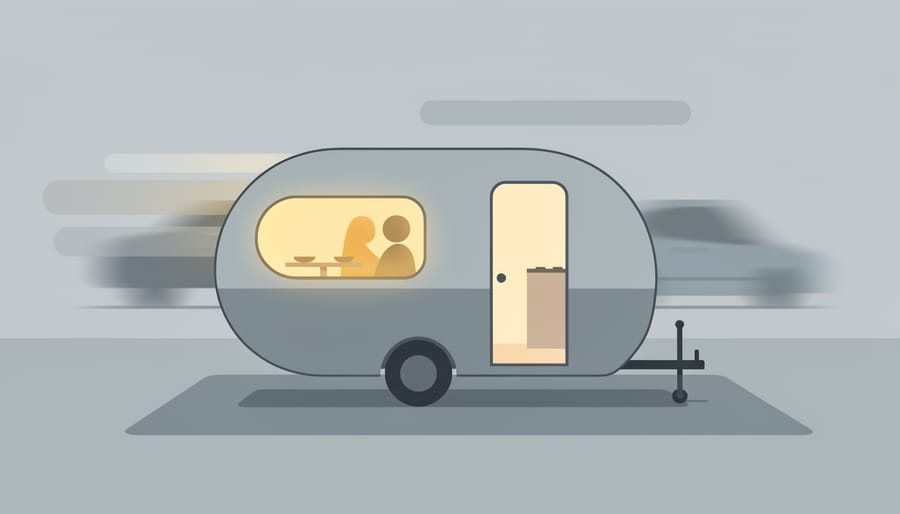
Managing Utilities and Hookups on the Road
Water Conservation Strategies
Living in a travel trailer means getting creative with your 30-50 gallon freshwater tank. We learned quickly that our old habits had to change, those leisurely showers and running water while washing dishes disappeared fast.
Start with the bathroom. Navy showers (water on to wet, off to soap, on to rinse) cut our water use by 70%. We installed a low-flow showerhead and keep a kitchen timer nearby. Five minutes feels luxurious now, and our kids turned it into a game.
In the kitchen, we use a spray bottle for rinsing dishes and catch gray water in a basin for pre-soaking. Quick RV cooking methods also reduce cleanup water needs significantly. Paper plates aren’t cheating when you’re boondocking, they’re practical.
For black tanks, we follow the “two flushes per solid” rule and always keep the valve closed until dumping. Gray tanks fill faster than you’d think, so we dump dish water outside when allowed at our site. A simple filter screen catches food particles before they enter the tank.
Power Management and Solar Options
Understanding your power needs starts with adding up your daily usage. Our family runs a laptop, phones, a small TV, LED lights, and occasionally a fan. That’s roughly 50-80 amp-hours per day. Most travel trailers come with a single 12-volt battery, which drains fast when you’re not plugged in.
We upgraded to two 6-volt golf cart batteries in series, giving us about 200 amp-hours of capacity. That lets us boondock comfortably for two to three days without recharging. Lithium batteries cost more but weigh less, charge faster, and last longer, worth considering if your budget allows.
Solar made sense for us after we started boondocking regularly. A 200-watt portable panel runs about $200 and keeps our batteries topped off in sunny weather. It paid for itself in saved campground fees within six months.
| Setup Option | Approximate Cost | Best For |
|---|---|---|
| Basic battery upgrade | $150-300 | Occasional boondocking, mostly hookups |
| 200W portable solar + controller | $250-400 | Weekend dry camping, flexibility |
| 400W roof-mounted system | $800-1,200 | Extended boondocking, full-time off-grid |
| Lithium battery bank + solar | $2,000-3,500 | Serious off-grid living, heavy power users |
Start small. Track your actual usage for a month before investing in expensive upgrades. Many families find that a modest solar setup and careful power habits work perfectly fine for full-time travel trailer life.
Where to Stay When You’re Living Full-Time
Finding the right places to park your travel trailer becomes second nature once you understand your options. We’ve stayed everywhere from luxury RV resorts to free BLM land, and each has its place in a full-time lifestyle.
For families just starting out, membership programs offer tremendous value. Thousand Trails and Passport America can cut your nightly costs in half, while Good Sam provides discounts at thousands of parks nationwide. We joined Thousand Trails our first year and calculated we saved over $3,000 compared to paying full price at private campgrounds. Harvest Hosts offers a completely different experience, free overnight stays at farms, wineries, and museums where you’re expected to make a small purchase. It’s perfect for breaking up long drives between destinations.
State and national parks provide incredible settings at reasonable prices, though they book up fast during peak season. Reserve six months ahead for popular locations, especially if you need a site that accommodates your trailer length. County parks and Army Corps of Engineers campgrounds are underrated gems, they’re typically less crowded and cost $15 to $25 per night with full hookups.
Boondocking on public land gives you free camping and stunning views, but requires self-sufficiency. We spend about 30% of our time off-grid, which keeps our monthly camping budget under $600. The key is learning where it’s legal, BLM land in the West, National Forest dispersed camping, and certain Walmart or Cracker Barrel parking lots for quick overnights.
Seasonal planning matters with kids. We follow moderate weather, heading north in summer and south in winter. This “snowbird” pattern means booking Gulf Coast spots by September for January availability. When you’re cooking those simple camp recipes in your trailer, having electric hookups during extreme temperatures makes life considerably easier.
Most full-timers mix it up, a month at a nice resort with amenities, two weeks boondocking to save money, then state parks for variety.
Budgeting for Full-Time Travel Trailer Living
Let’s talk money, because this is where full-time travel trailer living gets real. When we first crunched the numbers, I’ll admit I had no idea what we were actually signing up for. Our initial budget looked nothing like what we actually spent in those first six months.
The truth is, your monthly costs will vary wildly depending on where you park, how much you move, and what breaks. Here’s what a realistic monthly budget looks like based on our experience and conversations with dozens of other full-timing families:
| Expense Category | Low End | Average | High End |
|---|---|---|---|
| Campground/RV Park Fees | $300 | $600 | $1,200 |
| Fuel (towing/exploring) | $200 | $400 | $800 |
| Food/Groceries | $500 | $800 | $1,200 |
| Insurance (RV + vehicle) | $150 | $250 | $400 |
| Maintenance/Repairs | $100 | $300 | $600 |
| Phone/Internet | $100 | $150 | $250 |
Campground fees eat up the biggest chunk. We’ve stayed in places for $25 a night and others that charged $75. State parks and Corps of Engineers campgrounds offer the best value, especially if you snag a monthly rate. Annual memberships like Passport America or Thousand Trails can slash your camping costs in half if you plan your routes around their locations.
Fuel costs sting more than we expected. Pulling a travel trailer tanks your gas mileage, and if you’re moving weekly instead of monthly, that adds up fast. We learned to stay put longer and make day trips with just the truck.
The budget killer nobody warns you about is repairs and maintenance. Set aside at least $200 monthly, even if you’re not spending it right now. Travel trailers shake loose. Stuff breaks. We’ve replaced tires, fixed water heaters, and patched countless roof seals. Having that emergency fund saved us more than once.
Here’s what actually saves money: cooking in the trailer instead of eating out, staying at campgrounds with free laundry, using library wifi instead of expensive data plans, and joining local discount programs wherever you land. Shop at regional grocery chains, not tourist traps near campgrounds.
Our biggest shock? We actually spend less overall than we did in our stick-and-brick house, even with higher travel costs. No property taxes, minimal utility bills, and way less impulse buying when you have nowhere to put extra stuff.
Maintenance and Winterization Considerations
Our first winter in the travel trailer caught us off guard. We’d planned to chase warm weather south, but a family emergency kept us in Montana longer than expected. That crash course in cold-weather maintenance taught us that preventive care isn’t optional when your entire home is on wheels.
Monthly maintenance becomes second nature after a few months on the road. We check tire pressure every two weeks, inspect the roof for damage after storms, and test all appliances regularly. Travel trailers take more wear than stationary homes, so catching small issues early prevents expensive repairs. We learned to carry basic tools and spare parts because getting stranded with a leaky water pump three states from the nearest RV shop is no fun with kids in tow.
The roof deserves special attention. We inspect and reseal it twice yearly, focusing on vents, skylights, and antenna mounts where water loves to sneak in. One small leak can destroy walls and floors quickly in a travel trailer’s thin construction.
When we can’t outrun cold weather, winterization protects our investment. We blow out water lines with compressed air, add RV antifreeze to drains and the toilet, and cover exposed pipes. Skirting the trailer helps maintain livable temperatures and prevents freezing underneath. We also switch to winter-rated propane tanks and check furnace vents to ensure they’re not blocked by snow.
Some full-timers stay put in cold climates all winter. If you’re planning that, heated water hoses, tank heaters, and extra insulation become necessities rather than luxuries. We’ve met families who thrive in snowy destinations, but it requires more preparation and higher heating costs than mild-weather travel.
What We Wish We’d Known Before Starting
Looking back at our first year of full-time travel trailer living, I’d tell anyone considering this lifestyle to start smaller than you think you need. We assumed we’d require every inch of space we could afford, but quickly learned that less square footage actually meant less to clean, organize, and maintain. The sweet spot for our family turned out to be about 25 feet, not the 30-footer we originally thought was “minimum.”
I wish someone had warned us that the learning curve isn’t just about RV systems, it’s about each other. Living in close quarters magnifies every personality quirk and habit. My husband’s tendency to leave cabinet doors open became a legitimate safety hazard when I’d stand up and crack my head. We had to develop new communication patterns and establish clearer boundaries than we ever needed in a house. Give yourselves grace during this adjustment period. The first three months were honestly rough, but by month six, we’d found our rhythm.
The expense that blindsided us? Campground fees during shoulder seasons when we couldn’t boondock. We’d budgeted for summer and winter but didn’t account for those muddy spring weeks when dispersed camping wasn’t feasible. Similarly, we underestimated how much we’d spend eating out during the transition. Having a solid rotation for tasty meal prep would have saved us hundreds of dollars and considerable stress during those first months.
But here’s what surprised us most: the joy of waking up somewhere new whenever we wanted. That freedom to chase good weather, visit friends across the country, or simply relocate because we felt like it became addictive. Our kids adapted faster than we did, making friends at every campground and treating the whole country like their backyard. We thought we’d miss our house. Instead, we wondered why we’d waited so long to start this adventure.
Living full-time in a travel trailer has transformed how we experience the world as a family. We’ve traded square footage for stories, predictability for possibility, and the comfort of routine for the thrill of waking up somewhere new. It hasn’t always been easy. There are days when we miss having a yard, when the walls feel too close, or when managing laundry on the road tests our patience.
But here’s the truth: this lifestyle isn’t about escaping reality. It’s about choosing a different one. It’s watching your kids learn geography by living it, not memorizing it. It’s discovering that happiness doesn’t require more space, just the right perspective within the space you have.
Travel trailer living won’t suit everyone, and that’s perfectly fine. It demands flexibility, patience, and a willingness to adapt. But if you’re craving adventure, if you want your family to see more of this incredible country, if you’re ready to prioritize experiences over possessions, then maybe it’s time to seriously consider making the leap.
We’re here to help you on that journey. Explore our site for destination guides, practical RV tips, and real stories from families living this adventure every single day.